190 Years Ago, the Port of Odesa Welcomed “Karl the Great”
As part of the project «Incredible Port»
At the beginning of the century before last, when the era of rail and air transport was only beginning to take shape in practice, sea travel remained the best way to get from Ukraine to Europe, the Middle East, or the African continent.
For merchants and diplomats, military officers and artists alike, every such voyage by steamship was not merely a journey, but a distinct and vivid chapter of one’s biography – filled with unforgettable impressions from encounters with other civilizations and conversations with fellow passengers on board.
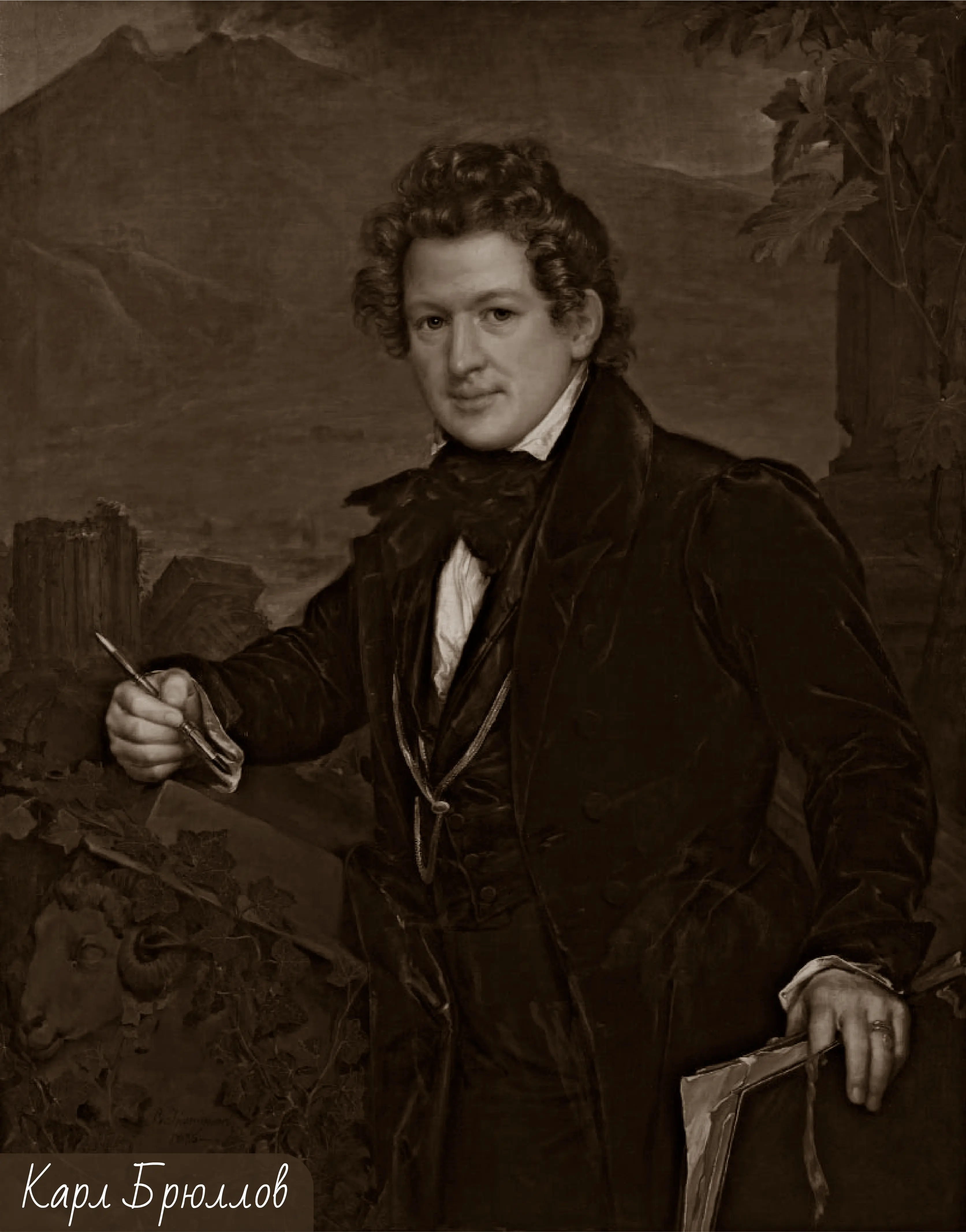
The Port of Odesa, as either the starting or ending point of a sea voyage, in turn received a share of the glory brought by distinguished transit passengers. In particular, the arrival in December 1835 from Italy via Constantinople of the artist Karl Bryullov – at that time a star of extraordinary, global magnitude – greatly flattered the pride of port workers and all of Odesa.
The prehistory of this event dates back to 1827, when the painter had the good fortune to visit the excavations of the city of Pompeii. As is well known, this ancient settlement was buried together with its inhabitants under a layer of ash as a result of the eruption of Mount Vesuvius in 79 AD.
Immersing himself for a long time in the atmosphere of the ruins and communicating with archaeologists, K. Bryullov literally ignited with the bold idea of creating an epic canvas depicting the tragedy of Pompeii. The path from conception to completion of the painting lasted a long six years. However, the artist’s triumph in Europe proved to be far more enduring. As modern art historians note, no European painter of the 19th century experienced such a grand success as befell Bryullov after the public presentation in mid-1833 of the painting The Last Day of Pompeii.
In the autumn of that same year, the canvas was exhibited in Milan, and K. Bryullov became the most famous person in Italy. He was greeted with applause in the streets, honored with ovations in theaters, and poets dedicated verses to him. While traveling between Italian principalities, the artist was not even required to present a passport – it was assumed that every Italian should recognize him by sight.
In 1834, The Last Day of Pompeii was presented at the Paris Salon, where the French Academy of Fine Arts awarded Bryullov a gold medal.
According to materials from the newspaper Odeskyi Lystok (The Odesa Leaflet), the renowned painter arrived in Odesa from Constantinople by steamship on December 17, 1835, and stayed in the city for more than three weeks – until January 9, 1836.
The people of Odesa welcomed the creator of The Last Day of Pompeii exceptionally warmly. On January 2, a festive dinner was held in his honor at one of the prestigious clubs of the “Southern Palmyra.”
In its report on this event, a correspondent of Odeskyi Lystok (issue of January 4, 1836) enthusiastically wrote: “Situated on the edge of Europe and far removed from the capitals of the enlightened world, we so rarely have the pleasure of seeing within our walls people marked by the seal of great talent that we could not but greet with genuine participation an artist who occupies such a high place in the esteem of his contemporaries.”
K. Bryullov’s return from Europe had an unexpected continuation, for which we, Ukrainians, remain grateful to the great master to this day.
In those same years, a numerous and influential St. Petersburg community of cultural figures from Ukraine took it upon themselves to support a talented compatriot – the young painter Taras Shevchenko, a serf of the landowner P. Engelhardt. Seizing the opportunity, the artist I. Soshchenko and the conference secretary of the Academy of Arts, V. Hryhorovych, introduced Taras Shevchenko to Professor K. Bryullov of the Academy.
It is known that after their first meeting, the great artist said to I. Soshchenko
“I like his face. There is nothing servile about it at all.”
This first impression proved decisive in shaping the future of the young poet. Bryullov personally stepped in to secure Taras Shevchenko’s freedom from serfdom. P. Engelhardt demanded an outrageously high price – 2,500 rubles, a sum equal at the time to about 35 kilograms of pure silver.
To raise this amount, Bryullov, at the request of his friend V. Zhukovsky, painted his portrait, which was raffled in a court lottery. The drawing took place on April 22, 1838, and already on May 4 the landowner signed the document granting freedom.
After his emancipation, Shevchenko became one of the most beloved students of “Karl the Great.” And the event itself, as later became clear, proved to be fateful not only for the biography of a single individual, but for the formation of an entire nation.