The Cinderellas of the State Grain Inspection
As part of the project «Incredible Port»
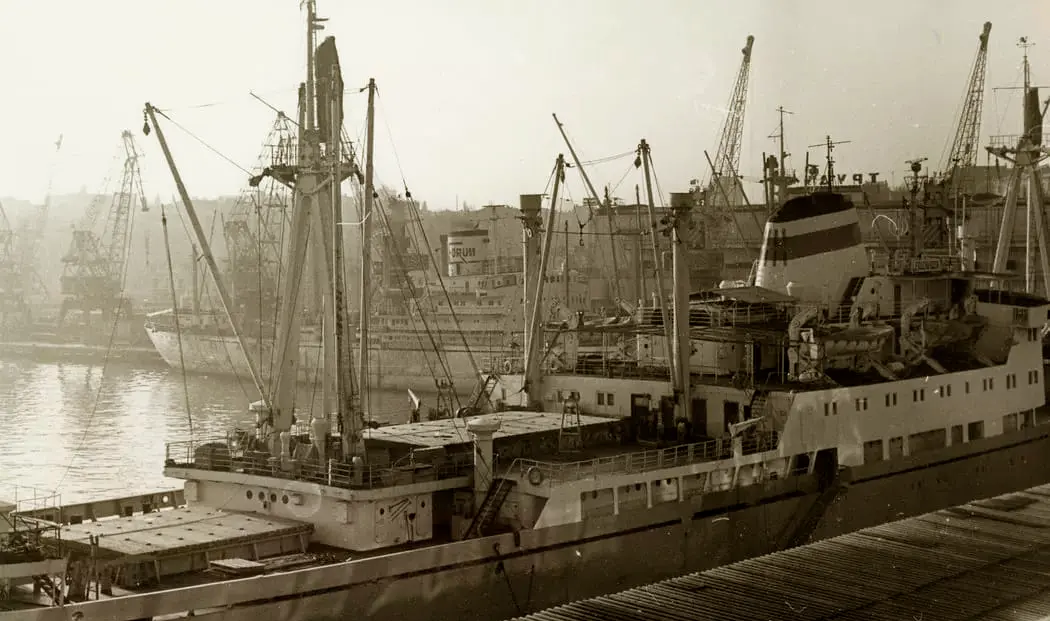
1963. With the beginning of large-scale transshipment of imported grain, the staff of the Odesa Port Unit of the State Grain Inspection was expanded by thirty positions. The best female graduates of agricultural colleges from southern Ukraine were sent to Odesa.
For thirty rural girls, it felt like winning the lottery. Almost every shift, a woman inspector would go out on patrol to inspect a foreign vessel. The launch approached the pier, and the watchman offered her his hand, as if to a young lady. When the launch lifted on a wave beside an ocean-going grain carrier, the girl jumped onto the step of the gangway without hesitation. She trusted the strong men’s hands that caught her in midair, just as the deck of the tiny launch dropped away beneath her.
The inspector took grain samples from every hold using a two-meter probe, pulled heavy buckets to the “office,” where analyses were carried out and conclusions written. On large vessels this was repeated several times. The hardest part came at the end, when only the grain at the bottom of the hold remained: twenty to thirty meters down a rope ladder, tools nearly clenched between the teeth, and then back up again. And there could be as many as seven holds.
Abroad, this work was done by men earning thirteen thousand dollars a year. Our girls were paid sixty-two rubles a month – less than a street cleaner. And yet, throughout the entire history of the Odesa Port Unit of the State Grain Inspection, not a single expert assessment was ever challenged. Yesterday’s village girls became specialists of the highest class, capable of determining grain quality with astonishing accuracy using nothing but the organoleptic method – by taste, smell, and color.
Poor uniforms – padded jackets and tarpaulin boots – backbreaking labor, constant awkwardness in front of foreigners. And at the same time – youth, beauty, and unspoiled souls. In fairy tales, such Cinderellas become princesses. In real life – wheezing, asthmatic breath. Today no one hides the fact that in the 1960s–80s imported grain was fumigated with military-grade poisonous gases left over from World War I. For the grain weevil, which devoured up to six percent of hard-currency wheat, it was “acid to the forelock.” But the women inspectors inhaled phosphine for a lifetime.
Captains looked at the women inspectors with irony: poverty, plain and simple. But once, as they say, one captain experienced true cognitive dissonance…
At the Odesa Port Unit of the State Grain Inspection worked an Odesa native, Lidiia Pronko. When she “went out into society,” the entire Peresyp district dressed her. One day, Lida ran to her shift straight from a celebration – wearing an evening gown, adorned with diamonds. She was immediately sent aboard a vessel. She only had time to remove her expensive ring and hand it to her young partner, Liudmyla Myronenko – afraid of losing it in the grain.
On an American freighter, the entire crew gathered by the hatch: a woman in an evening dress, glittering with diamonds, was driving a probe into wheat. The Greek captain could not understand why such a wealthy lady was working at night, deep in the hold.
Meanwhile, “Mirosha,” without taking the ring off, was washing the laboratory floor. She washed thoroughly, as she had been taught – changing the water several times. Then she sat down to read Maupassant. The novella was titled The Necklace. It was a moving story of a poor girl, Mathilde Loisel, who borrowed a diamond necklace from her wealthy friend, lost it, and then spent ten years repaying its cost with her husband. Before reaching the end of the story, Lyuda took the ring off her finger and clenched it tightly in her fist.
The history of the Odesa Port Unit of the State Grain Inspection in the 1960s–80s is a story about women who worked at the very limits of human endurance without losing their dignity. Most of them remained Cinderellas who never lived to meet their Fairies. And yet…
When the planned economy gave way to the market, and Ukraine became one of the world’s major grain exporters, the working conditions of grain inspectors changed. Today, every company that handles grain through the Port of Odesa has its own certified laboratory, equipped with modern digital equipment.
The young women working as laboratory technicians in grain quality control are no longer engaged in physical labor. And, in truth, the only thing that connects them to the work of their grandmothers in the 1960s is their high level of professional skill – and their love for the profession.