"Odesa Port Worker": A 70-Year Chronicle of Memory
As part of the “Incredible Port” project
There are things whose value cannot be measured by circulation numbers — even if the first print run consisted of only two thousand copies.
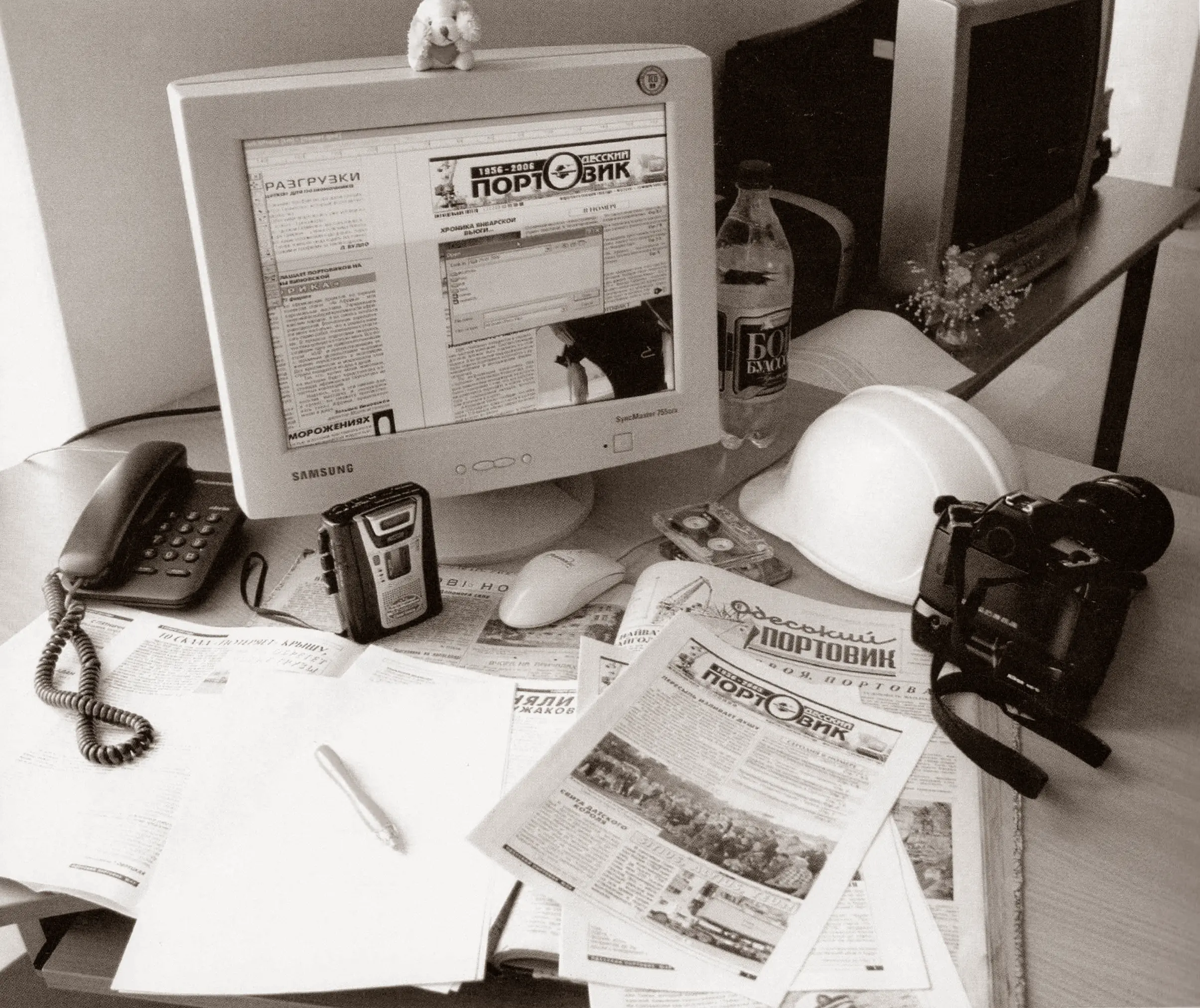
On 5 September 1956, the first issue of Odesa Port Worker (Odeskyi Portovyk) was printed at the Moriak publishing house. Its first editor was Lev Rushchynskyi, Head of the Port Planning Department, while its first correspondent was war veteran Markus Rashkovetskyi. Few could have imagined then that this modest port newspaper would endure for nearly seven decades and become far more than a newspaper—it would become the true chronicle of the Odesa Port.
Today, going through its old bound volumes, one realizes that the history of the port has been preserved not only in archival records, but also on the pages of this newspaper.
Week after week, Odesa Port Worker documented the life of one of the country's largest ports. Cargo from dozens of countries passed through its berths.
Major international projects were launched and completed here. New terminals were built, new technologies introduced, while eras, states, and economic systems changed around them.
The newspaper covered the operations of Indian and Cuban shipping lines, humanitarian assistance to Vietnam, shipments for the construction of the Aswan High Dam, grain convoys arriving from Canada and the United States, as well as the rise and eventual disappearance of the Crimean–Caucasian shipping line. Its pages reflected the technical modernization of the port's berths, the emergence of container terminals, the reforms of independent Ukraine, and the difficult challenges of a new era.
Yet the newspaper's greatest asset was never the scale of the events it reported. Its greatest asset was its people.
Longshoremen and machine operators. Dockers and port fleet seafarers. Engineers, dispatchers, stevedores, and foremen. Those who welcomed ships at night and worked through storms. Those whose names never appeared in history textbooks, yet who shaped the history of the port with their own hands every single day.
Odesa Port Worker preserved thousands of names. For many families, a newspaper article became the only lasting reminder that someone's work had been noticed and appreciated. That is why each issue was eagerly awaited, carefully read, discussed on the quays and during production meetings, passed from hand to hand, and preserved at home for years.
Beginning in the early 1990s, as the port entered a new era and companies of various forms of ownership began operating within the port community, the newspaper became an important platform for dialogue between the port authority, trade unions, and labour collectives. It united the diverse port community, which grew increasingly complex and multifaceted with each passing year.
Over the years, its pages featured the work of distinguished Odesa journalists, including Valerii Smyrnov, Feliks Kokhrikht, Oleh Ordanovskyi, Valerii Barskyi, Ihor Medvedovskyi, Larysa Bullo, Tetiana Ovrutska, Vasyl Volianskyi, and Nataliia Stepanova. Their articles created a vivid portrait of their time. The newspaper's modern visual identity was shaped by layout designer Serhii Aliokhin.
The last quarter-century of Odesa Port Worker's history is inseparably linked with the name of Oleksii Stetsiuchenko—a journalist, publicist, researcher, and one of Ukraine's foremost chroniclers of the port industry. He joined the newspaper as a correspondent in 1999 and became its Editor-in-Chief in 2005.
For him, the port was never merely an industrial facility. His stories were always about people—their lives, their characters, their achievements, and the challenges they overcame. His respect for working people was evident in every line he wrote. Thanks to authors like him, the newspaper remained authentic, honest, and close to its readers.
In 2026, Oleksii Stetsiuchenko concluded his many years of service at the port and retired. Yet the connection between a person and the work of a lifetime is not always defined by a job title or an office.
Even today, he remains closely connected to the port. He continues researching its history, working on new publications, and is one of the authors of the “Incredible Port” series, helping preserve the memory of the people and events that shaped maritime Odesa.
As a consequence of russia's full-scale war against Ukraine, Odesa Port Worker was forced to cease publication..
Yet perhaps the age of a true chronicle is measured differently.
A newspaper lives as long as people continue to open its old bound volumes. As long as someone recognizes their father, grandfather, or colleague in a faded photograph. As long as the names of those who once worked honestly and professionally on the port's berths continue to be spoken.
In 2026, Odesa Port Worker would have celebrated its 70th anniversary.
Would have.
But in the history of the Odesa Port, there are symbols that do not disappear with the publication of the final issue. They remain as the memory of their time. Odesa Port Worker is one of those symbols. And as long as its bound volumes are opened, its authors remembered, and its readers cherish its pages, its story continues.