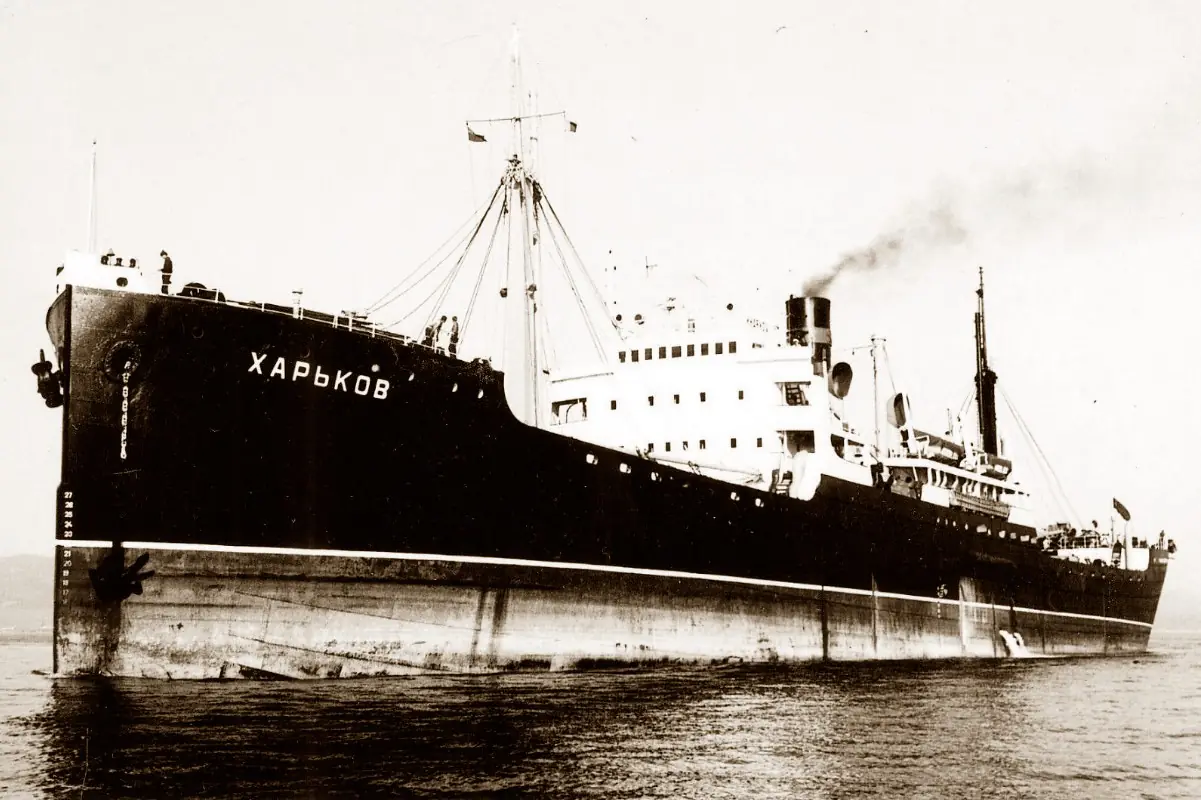
Kharkiv – The Longest Steamship in the World
As part of the “Incredible Port” project
The history of the Port of Odesa is filled with remarkable voyages, but some of them sound more like maritime legends. One such story is connected with the steamship “Kharkiv”, which was once jokingly referred to as the longest ship in the world.
On 30 March 1938, a unique expedition departed from Odesa for the Soviet Far East. The steamship “Kharkiv”, the tugboat “Typhoon”, and a massive all-welded floating dock with a lifting capacity of 5,000 tonnes formed a convoy unlike almost anything the world of maritime navigation had ever seen.
In less than three months, the crews covered more than 11,000 nautical miles, sailing across the Black, Marmara, Aegean, Red, Arabian, and South China seas, and crossing the Indian and Pacific oceans. Along the way, they encountered storms, powerful currents, and exhausting tropical heat that caused the machinery to overheat. The deck of the floating dock carried additional launches and lighters, while “Kharkiv's” holds were loaded with thousands of tonnes of cargo, coal, and fresh water. This allowed the convoy to avoid unnecessary calls at foreign ports and significantly reduce operating costs.
On 20 June, the convoy safely arrived at the roadstead of Petropavlovsk-Kamchatsky. The successful completion of the voyage demonstrated that precise engineering, the professionalism of Captains Heorhii Mezentsev and Vitalii Tsilke, and the endurance of their crews could accomplish what had once seemed impossible.
Yet “Kharkiv” had earned its greatest fame several years earlier—and under entirely different circumstances.
In the spring of 1933, the steamship departed from Mykolaiv carrying a cargo of legumes bound for European ports. On 8 March, in dense fog near the Bosphorus, the vessel struck a rocky shoal and ran aground. While awaiting salvage assistance, a storm developed and severely damaged the hull.
What happened next became one of the best-known stories in maritime history. Seawater entered the cargo hold through a breach in the hull. The peas absorbed the water, swelled dramatically, and exerted such tremendous pressure that they deformed the bulkheads, tore away the frames, and literally split the steamship in two.
It seemed that this was the end of the vessel. However, because the accident occurred in shallow waters, both sections remained afloat. The bow was towed to Sevastopol for repairs, while the stern remained temporarily in Istanbul, where it was reinforced before also being transported to the shipyard.
It was then that sailors coined the famous joke: “Kharkiv” is the longest steamship in the world, because her bow is in Sevastopol while her stern is in Constantinople."
The specialists of the Sevastopol Shipyard performed what was widely regarded as a miracle of ship repair. In a dry dock, the two halves of the vessel were aligned with extraordinary precision and welded back into a single structure. The operation demanded exceptional accuracy, as even the slightest misalignment could have compromised the hull's strength.
On 18 May 1934, “Kharkiv”—which only months earlier had existed as two separate halves in two different cities—returned to the sea, becoming a legend in the history of ship repair.
Perhaps that is why the vessel's participation in the 1938 Odesa expedition was seen as deeply symbolic. A steamship that had once been brought back to life against all odds went on to take part in an operation that became an integral part of Odesa's maritime heritage and secured its place in the history of world seafaring.