WHEN THE MOST PRECIOUS THING IN LIFE IS A PORT PASS
As part of the project “Incredible Port”
Vorontsov Lighthouse… At night, its light is visible from afar - fifteen nautical miles away. The rhythmic flashes of red light resemble someone’s breathing. It is the port itself breathing. In clear weather - silently; in fog - resonantly, laboriously, with a hint of unease…
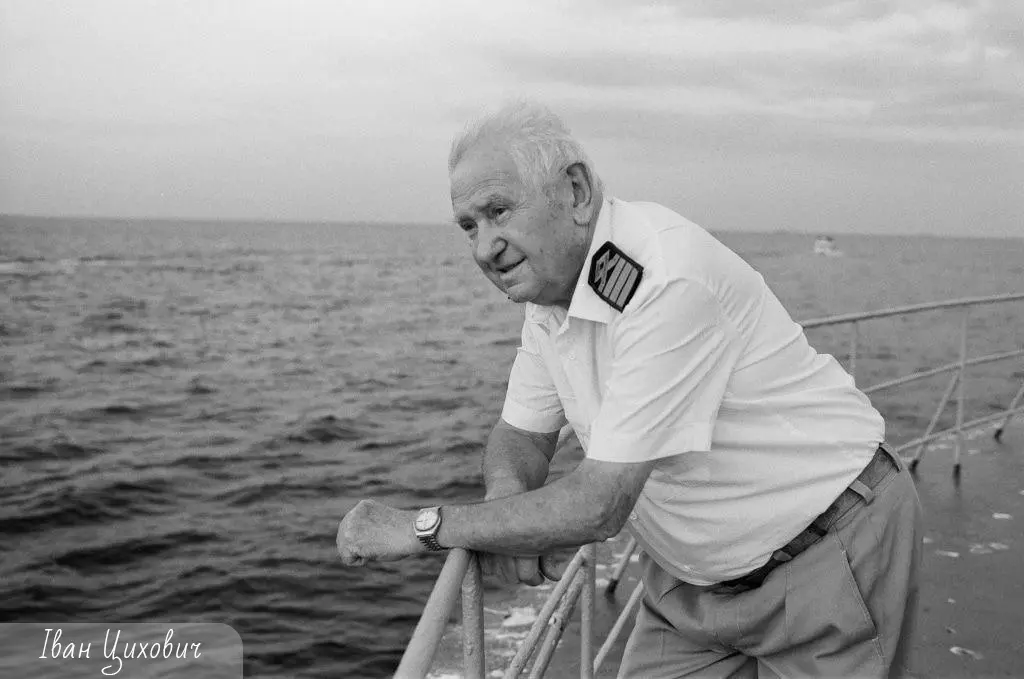
For sixty-five years, Ivan Tsikhovych oversaw the operation of the light-optical apparatus and the fog signal system (nautophone) on the white tower of the lighthouse. Sixty-five years! An entire life beside the lighthouse. And this is not a metaphor: Ivan Tsikhovych lived in the port all this time—first in the so-called Vorontsov Lighthouse settlement (built at the beginning of the 20th century on the northern part of the former Austrian Beach), and later, after the modernization of the container terminal on the Quarantine Mole, in a modular house near the meteorological station. It is no wonder that when the honored lighthouse keeper retired in June 2021, his name appeared in all Ukrainian news outlets.
March 1956. Demobilized first-class radio operator Ivan Tsikhovych was appointed caretaker of the Vorontsov Lighthouse. At that time, the lighthouse watch was always kept by two people: they had to monitor the diesel generators, in winter keep the fire burning in the stove, and carry bags of coal along the narrow Quarantine Mole. During a single cold season, the lighthouse keepers burned seven tons of coal…
On 2 January 1957, lighthouse caretakers Ivan Tsikhovych and his colleague Valentyn Kozlovych were returning to the port after their shift. Suddenly, a storm arose, and the wind periodically swept waves across the stone path of the Quarantine Mole. One of these waves, as if playing, washed both lighthouse keepers into the water.
The sailors at the rescue post quickly lowered the lifeboat and threw in the oars, but they searched for the two keepers for a long time. During this time, Kozlovych was carried almost into the fairway, while Tsikhovych desperately paddled toward the Quarantine Mole. Three times he reached the slippery concrete from a distance of five meters - and three times a wave threw him back. The fourth time he didn’t even try - he was exhausted. His insulated clothing - a pea coat and quilted trousers - weighed him down like a stone in the icy abyss.
Twenty-five minutes in freezing water! Both were rescued. When Tsikhovych was hauled into the lifeboat without his outerwear, the first thing the lighthouse keeper asked, once he regained consciousness, was:
— Where is my pea coat? The pass is in the coat. Without the pass, they won’t let me into the port.
The next day, the sea froze over…
After this near-tragic incident, Tsikhovych decided that measures had to be taken so that no one would risk their life going to the lighthouse in a storm. Possessing an engineering streak, Ivan Tsikhovych quickly developed a remote-control device for the flashing lights and the nautophone. He borrowed the principle from telephone code signaling…
When the “Lighthouse Keeper’s Trail” tour route opened at the port in 2011, Ivan Tsikhovych welcomed visitors at its final point - right at the foot of the tower. Visitors had the opportunity to speak personally with the legendary caretaker. Those lucky enough to see the apparatus room on the lower level of the lighthouse say it is a true museum of technology. Nearby are diesel generators, transmitters, and other devices representing three eras of technological progress: vacuum tube, transistor, and digital.
All this treasure Ivan Tsikhovych passed to his successor in perfect condition. And only the port pass - the very first one, he kept for himself.